
Two rows: project, branch and changed-file and line counts on top, then model, effort, a context bar and five-hour and seven-day bars that stack usage against time elapsed. Reads the Fable weekly limit from Claude Code's cache, falling back to api.anthropic.com with your Claude login; on macOS that reads the Keychain item 'Claude Code-credentials', which can ask permission once.
0 copies
Preview
app ⎇ main
⠀
★ Opus 4.8 · high │ Ctx ██▏        22% 45k │ 5h ▀▀▀▀▀▀▀▀▀▀ 26% ↻2h6m │ 7d ▀▀▀▀▀▀▀▀▀▀ 7% ↻2d0h
app ⎇ main
⠀
★ Opus 4.8 · high
app ⎇ feat/auth                                                                                     1 mod  1 ? │ +1
⠀
★ Sonnet 4.6 · med │ Ctx ████▊      48% 97k │ 5h ▀▀▀▀▀▀▀▀▀▀ 40% ↻1h11m │ 7d ▀▀▀▀▀▀▀▀▀▀ 18% ↻2d21h
app ⎇ main
⠀
★ Opus 4.8 · max │ Ctx █████████  91% 183k │ 5h ▀▀▀▀▀▀▀▀▀▀ 88% ↻17m │ 7d ▀▀▀▀▀▀▀▀▀▀ 61% ↻19h59m
app ⎇ main
⠀
★ Haiku 4.5 │ 5h ▀▀▀▀▀▀▀▀▀▀ 52% ↻4h1m
feature ⎇ worktree-feature
⠀
★ Opus 4.8 · low │ Ctx ███▋       37% 75k │ 5h ▀▀▀▀▀▀▀▀▀▀ 44% ↻2h49m │ 7d ▀▀▀▀▀▀▀▀▀▀ 20% ↻1d6h
scratch
⠀
★ Opus 4.8 · high │ Ctx ██▏        22% 45k
What it does
Two rows: project, branch and changed-file and line counts, then model, effort, a context bar and 5-hour and 7-day bars that stack usage against time elapsed, plus Fable weekly use.
- Written in
- Bash
- Network access
- api.anthropic.com
- Reads your Claude login
- To fetch your Fable weekly limit when its caches are stale
- Works in
- Terminal
How it works
- Reads model, effort, context and limits from stdin, and file and line changes from git.
- Each limit bar stacks usage over time elapsed, and usage turns red when it runs ahead.
- Gets the Fable weekly limit from ~/.claude.json, or its own copy in ~/.claude/cache/.
- A new session shows only model and effort. Edits add counts like 1 mod 1 ? and +1.
Good to know
- If both copies are 30+ min old, it sends your token to api.anthropic.com/api/oauth/usage, max every 10 min.
- Takes the token from ~/.claude/.credentials.json or Keychain Claude Code-credentials (can prompt once).
- Needs jq, git and curl. Keeps oauth-usage.json and an .attempt stamp in ~/.claude/cache/.
Source
#!/usr/bin/env bash
# Claude Code statusline, two rows:
#   dir ⎇ branch                         3 mod │ +182 -47
#
#   ★ Model · effort │ Ctx ▓▓░ 9% 90k │ 5h ▓░░ 4% ↻2h │ 7d ▓▓░ 16% ↻3d10h
# Reads the statusline JSON from stdin (see https://code.claude.com/docs/en/statusline.md)

input=$(cat)

# Tab is an IFS whitespace character, so bash collapses a run of tabs: one
# empty field would shift every value after it. `d` keeps the text fields
# non-empty. A path cannot hold U+001F, so it stands in for "no directory"
# and is cleared right after the read.
IFS=$'\t' read -r model effort dir version ctx_pct ctx_tokens five_pct five_reset week_pct week_reset <<<"$(jq -r '
def d($fallback): if (. // "") == "" then $fallback else . end;
[
  (.model.display_name | d("?")),
  ((.effort | objects | .level) // "" | d("\u001f")),
  (.workspace.current_dir // .cwd | d("\u001f")),
  (.version | d("2.1.211")),
  (.context_window.used_percentage // -1 | round),
  ((.context_window.total_input_tokens // 0) + (.context_window.total_output_tokens // 0) | round),
  (.rate_limits.five_hour.used_percentage // -1 | round),
  (.rate_limits.five_hour.resets_at // 0),
  (.rate_limits.seven_day.used_percentage // -1 | round),
  (.rate_limits.seven_day.resets_at // 0)
] | @tsv' <<<"$input")"
[[ $dir == $'\x1f' ]] && dir=""
[[ $effort == $'\x1f' ]] && effort=""   # absent for models without an effort setting

# --- Fable weekly window: not in the statusline JSON. Primary source is the
# CLI's own persisted copy of its last successful /api/oauth/usage fetch
# (cachedUsageUtilization in ~/.claude.json, kept fresh by the running TUI).
# Only when that is stale (>30 min) do we fetch the endpoint ourselves, in the
# background, at most every 10 min — its per-token quota is tiny and shared
# with the TUI, so we stay out of its way.
USAGE_CACHE="$HOME/.claude/cache/oauth-usage.json"
USAGE_STAMP="$HOME/.claude/cache/oauth-usage.attempt"
now_s=$(date +%s)
# GNU stat first: BSD stat (macOS) rejects -c cleanly, but GNU stat reads -f as
# --file-system and dumps the whole file system to stdout before it fails.
mtime() {
  local t
  t=$(stat -c %Y "$1" 2>/dev/null) || t=$(stat -f %m "$1" 2>/dev/null)
  [[ $t =~ ^[0-9]+$ ]] || t=0
  echo "$t"
}
file_age() { [[ -f "$1" ]] && echo $(( now_s - $(mtime "$1") )) || echo 999999; }

cache_ts=0; [[ -f "$USAGE_CACHE" ]] && cache_ts=$(mtime "$USAGE_CACHE")
cli_ts=$(jq -r '.cachedUsageUtilization.fetchedAtMs // 0 | . / 1000 | floor' "$HOME/.claude.json" 2>/dev/null)
cli_ts=${cli_ts:-0}
if (( cli_ts >= cache_ts )); then
  usage_json=$(jq -c '.cachedUsageUtilization.utilization // empty' "$HOME/.claude.json" 2>/dev/null)
  best_ts=$cli_ts
else
  usage_json=$(cat "$USAGE_CACHE" 2>/dev/null)
  best_ts=$cache_ts
fi

if (( now_s - best_ts > 1800 )) && (( $(file_age "$USAGE_STAMP") > 600 )); then
  touch "$USAGE_STAMP"
  (
    tok=$(jq -r '.claudeAiOauth.accessToken // empty' "$HOME/.claude/.credentials.json" 2>/dev/null)
    # macOS keeps the token in the Keychain, not in .credentials.json. Reading it
    # from here can raise a Keychain dialog once, because the ACL is per binary.
    # Set CLAUDE_STATUSLINE_NO_KEYCHAIN=1 to skip the lookup and the dialog.
    if [[ -z "$tok" && -z "$CLAUDE_STATUSLINE_NO_KEYCHAIN" ]]; then
      tok=$(security find-generic-password -s "Claude Code-credentials" -w 2>/dev/null \
        | jq -r '.claudeAiOauth.accessToken // empty' 2>/dev/null)
    fi
    [[ -n "$tok" ]] || exit 0
    resp=$(curl -sS --max-time 5 https://api.anthropic.com/api/oauth/usage \
      -H "Authorization: Bearer $tok" -H "anthropic-beta: oauth-2025-04-20" \
      -H "Content-Type: application/json" \
      -H "User-Agent: claude-cli/$version (external, cli)" 2>/dev/null)
    if jq -e 'has("limits") or has("five_hour")' <<<"$resp" >/dev/null 2>&1; then
      printf '%s' "$resp" > "$USAGE_CACHE.tmp" && mv "$USAGE_CACHE.tmp" "$USAGE_CACHE"
    fi
  ) >/dev/null 2>&1 &
fi

# The Fable weekly window is a "weekly_scoped" entry in the usage payload's
# .limits array: {kind, scope.model.display_name, percent (0-100), resets_at}.
fable_pct=-1 fable_reset=0
if [[ -n "$usage_json" ]]; then
  IFS=$'\t' read -r fable_pct fable_reset_raw <<<"$(jq -r '
    (.limits // [] | map(select(.kind == "weekly_scoped"
      and ((.scope.model.display_name // "") | ascii_downcase | contains("fable"))))
      | first) as $f |
    [($f.percent // -1 | round), ($f.resets_at // 0)] | @tsv' <<<"$usage_json" 2>/dev/null)"
  fable_pct=${fable_pct:--1}
  if [[ "$fable_reset_raw" =~ ^[0-9]+$ ]]; then
    fable_reset=$fable_reset_raw
  elif [[ -n "$fable_reset_raw" ]]; then
    # BSD date (macOS) has no -d. Its -f parser also chokes on the fractional
    # seconds and the offset, so feed it the first 19 chars. resets_at is UTC,
    # and -u makes BSD date read those 19 chars as UTC too.
    fable_reset=$(date -d "$fable_reset_raw" +%s 2>/dev/null \
      || date -j -u -f '%Y-%m-%dT%H:%M:%S' "${fable_reset_raw:0:19}" +%s 2>/dev/null \
      || echo 0)
  fi
fi

RESET='\033[0m'
DIM='\033[38;2;138;138;138m'
SEP='\033[38;2;55;55;55m'
BOLD='\033[1m'
AMBER='\033[38;2;255;175;60m'
GREEN='\033[38;2;140;194;74m'
RED='\033[38;2;220;60;60m'
TRACK='48;2;55;55;55'

# limit color (5h/7d/Fable): green < 50, yellow 50-80, red > 80 (truecolor RGB)
pct_color() {
  if   (( $1 > 80 )); then echo '38;2;220;60;60'
  elif (( $1 >= 50 )); then echo '38;2;220;200;60'
  else                     echo '38;2;140;194;74'
  fi
}

# pace color (stacked bar top row): usage vs window-time-elapsed. Green when
# usage trails the blue row, yellow within ±5 points (half a cell), red when it
# leads — leading pace hits 100% before the window resets.
pace_color() {
  local diff=$(( $1 - $2 ))
  if   (( diff > 5 ));   then echo '38;2;220;60;60'
  elif (( diff >= -5 )); then echo '38;2;220;200;60'
  else                        echo '38;2;140;194;74'
  fi
}

# context color: green < 25, yellow 25-49, red >= 50 (tighter — context fills fast)
ctx_color() {
  if   (( $1 >= 50 )); then echo '38;2;220;60;60'
  elif (( $1 >= 25 )); then echo '38;2;220;200;60'
  else                     echo '38;2;140;194;74'
  fi
}

# bar <pct> <width> [color_fn] — solid fill with 1/8-block resolution on a dark track
bar() {
  local pct=$1 w=$2 color_fn=${3:-pct_color} fg partials=("" "▏" "▎" "▍" "▌" "▋" "▊" "▉")
  (( pct < 0 )) && pct=0; (( pct > 100 )) && pct=100
  fg=$($color_fn "$pct")
  local eighths=$(( pct * w * 8 / 100 ))
  local full=$(( eighths / 8 )) part=$(( eighths % 8 ))
  local out="" i
  for (( i = 0; i < full; i++ )); do out+="█"; done
  out+="${partials[$part]}"
  local used=$(( full + (part > 0 ? 1 : 0) ))
  printf '\033[%s;%sm%s%*s\033[0m' "$TRACK" "$fg" "$out" $(( w - used )) ""
}

# stacked_bar <usage_pct> <elapsed_pct> <width> — usage (top, pace-colored)
# over window-time-elapsed (bottom, blue) in the same cells: each cell is ▀ with
# fg = top half, bg = bottom half. Usage sticking out past blue = burning too fast.
stacked_bar() {
  local u=$1 t=$2 w=$3
  (( u < 0 )) && u=0; (( u > 100 )) && u=100
  (( t < 0 )) && t=0; (( t > 100 )) && t=100
  local ufg=$(pace_color "$u" "$t") bluebg='48;2;40;80;130' trackfg='38;2;55;55;55'
  local ucells=$(( (u * w + 50) / 100 )) tcells=$(( (t * w + 50) / 100 ))
  (( u > 0 && ucells == 0 )) && ucells=1
  (( t > 0 && tcells == 0 )) && tcells=1
  local i fg bg out=""
  for (( i = 0; i < w; i++ )); do
    (( i < ucells )) && fg=$ufg || fg=$trackfg
    (( i < tcells )) && bg=$bluebg || bg=$TRACK
    out+="\033[${fg};${bg}m▀"
  done
  printf '%b\033[0m' "$out"
}

# fmt_tokens <count> — context tokens, always in thousands: 1k … 999k. A live
# session is never really at 0k, so anything under 500 rounds up to 1k instead
# of down to a 0k that reads like "nothing loaded".
fmt_tokens() {
  local k=$(( ($1 + 500) / 1000 ))
  (( k < 1 )) && k=1
  (( k > 999 )) && k=999
  echo "${k}k"
}

# fmt_reset <epoch> — time until reset: now / 45m / 7h9m / 3d10h
fmt_reset() {
  local diff=$(( $1 - $(date +%s) ))
  if   (( diff <= 60 ));    then echo "now"
  elif (( diff < 3600 ));   then echo "$(( diff / 60 ))m"
  elif (( diff < 86400 ));  then echo "$(( diff / 3600 ))h$(( diff % 3600 / 60 ))m"
  else echo "$(( diff / 86400 ))d$(( diff % 86400 / 3600 ))h"
  fi
}

# --- display width. A terminal counts columns; bash counts characters. CJK
# and emoji take two columns, and under a non-UTF-8 locale bash counts bytes,
# where cutting a string mid-sequence would write invalid UTF-8 to the
# terminal. `UTF8` records whether this shell sees characters at all. ASCII,
# which is almost every name, skips the whole thing.
utf8_probe='ää'
[[ ${#utf8_probe} == 2 ]] && UTF8=1 || UTF8=''

is_ascii() { [[ $1 != *[^\ -~]* ]]; }

# wide <codepoint> — the ranges a terminal draws two columns wide
wide() {
  local c=$1
  (( c >= 0x1100 )) || return 1
  (( c <= 0x115f || c == 0x2329 || c == 0x232a \
     || ( c >= 0x2e80 && c <= 0xa4cf && c != 0x303f ) \
     || ( c >= 0xac00 && c <= 0xd7a3 ) || ( c >= 0xf900 && c <= 0xfaff ) \
     || ( c >= 0xfe30 && c <= 0xfe6f ) || ( c >= 0xff00 && c <= 0xff60 ) \
     || ( c >= 0xffe0 && c <= 0xffe6 ) || ( c >= 0x1f300 && c <= 0x1faff ) \
     || ( c >= 0x20000 && c <= 0x3fffd ) ))
}

# vis_len <string> — how many columns the string occupies
vis_len() {
  local s=$1 n=0 i cp
  if is_ascii "$s" || [[ -z $UTF8 ]]; then echo "${#s}"; return; fi
  for (( i = 0; i < ${#s}; i++ )); do
    printf -v cp '%d' "'${s:i:1}"
    if wide "$cp"; then n=$(( n + 2 )); else n=$(( n + 1 )); fi
  done
  echo "$n"
}

# vis_cut <string> <columns> — the longest prefix that fits in that many
# columns. A shell that cannot see characters leaves a multibyte string whole
# rather than splitting a sequence in half.
vis_cut() {
  local s=$1 max=$2
  is_ascii "$s" && { echo "${s:0:max}"; return; }
  [[ -z $UTF8 ]] && { echo "$s"; return; }
  local n=0 i cp w out=''
  for (( i = 0; i < ${#s}; i++ )); do
    printf -v cp '%d' "'${s:i:1}"
    w=1; wide "$cp" && w=2
    (( n + w > max )) && break
    out+=${s:i:1}; n=$(( n + w ))
  done
  echo "$out"
}

# short_model <display_name> — "Claude Opus 4.8" -> "Opus 4.8",
# "Opus 5 (1M context)" -> "Opus 5 1M". The CLI builds the long form by
# appending " (1M context)" to a registry display_name whenever the model id
# carries the [1m] suffix, so undoing exactly that is safe.
short_model() {
  local m=${1#Claude }
  # printf, not echo: a display name of "-e" or "-n" would be eaten as a flag
  printf '%s' "${m/ (1M context)/ 1M}"
}

# effort_label <level> — the five levels the CLI sends, short enough to sit
# next to the model name
effort_label() {
  case $1 in
    low)    echo "low"  ;;
    medium) echo "med"  ;;
    high)   echo "high" ;;
    xhigh)  echo "xhi"  ;;
    max)    echo "max"  ;;
    *)      echo ""     ;;
  esac
}

# word_trim <string> <max> — shorten to <max> columns, cutting at the word
# boundary nearest the limit. A boundary further back than 3 columns throws
# away more than it saves, so that falls through to a hard cut.
word_trim() {
  local s=$1 n=$2
  (( $(vis_len "$s") <= n )) && { printf '%s' "$s"; return; }
  local cut best="" i
  cut=$(vis_cut "$s" $(( n - 1 )))            # the … takes the last column
  [[ $cut == "$s" ]] && { printf '%s' "$s"; return; }   # nothing safe to cut
  for (( i = ${#cut}; i >= 4; i-- )); do
    [[ ${cut:i:1} == [-_./] ]] && { best=${cut:0:i}; break; }
  done
  (( ${#best} < ${#cut} - 3 )) && best=$cut
  printf '%s' "${best}…"
}

# plain <string> — the string without its color escapes, for measuring. Two
# kinds appear: the palette variables hold the literal text \033[..m, which
# printf %b turns into escapes only at output, while bar() and stacked_bar()
# run their own output through printf %b and so return real escape bytes.
plain() {
  local s=$1 out=""
  while [[ $s == *'\033['* ]]; do
    out+=${s%%'\033['*}; s=${s#*'\033['}; s=${s#*m}
  done
  s="$out$s"; out=""
  while [[ $s == *$'\033['* ]]; do
    out+=${s%%$'\033['*}; s=${s#*$'\033['}; s=${s#*m}
  done
  printf '%s' "$out$s"
}

# join_row <segments...> — the segments with " │ " between them
join_row() {
  local out="" s
  for s in "$@"; do
    [[ -n "$out" ]] && out+=" ${SEP}│${RESET} "
    out+="$s"
  done
  printf '%s' "$out"
}

row_width() { vis_len "$(plain "$1")"; }

# The project and the branch share one column budget. Nothing is shortened
# while both fit; past that the branch gives up its namespace, then its tail,
# and only then does the project give up anything.
#
# The budget is whatever row 1 has left after the file and line groups, which
# is most of the terminal. Claude Code captures the script's output rather than
# giving it a terminal, so `tput cols` reads nothing; it passes the width in
# COLUMNS instead (v2.1.153 or later). Older versions send no width, and then
# the budget is a fixed LOC_FALLBACK that suits an 80-column terminal.
LOC_GLUE=3          # the " ⎇ " between the two
LOC_MARGIN=1        # a column kept free at the end of the row
LOC_FLOOR=24        # never squeeze the pair below this, however narrow the term
LOC_FALLBACK=64     # the budget when the terminal width is unknown
BRANCH_FLOOR=12     # the shortest branch worth printing
PROJECT_FLOOR=10    # the shortest project worth printing

# Row 1 is the checkout and what has changed in it. Row 2 is the instrument
# panel: the model and the bars.
row1=()
row2=()

# directory + git branch. A linked worktree's private git dir holds a
# `commondir` file and the main .git never does — a path-string comparison of
# --git-dir and --git-common-dir cannot tell them apart, because git returns
# one absolute and one relative from a subdirectory. In a worktree the glyph
# becomes an amber ⎇+ instead of ⎇.
if [[ -n "$dir" ]]; then
  project=$(basename "$dir")
  branch=$(git -C "$dir" branch --show-current 2>/dev/null)

  # ⎇+ is one column wider than ⎇, and with no branch there is no glyph at
  # all, so the project gets the whole budget
  worktree=""
  if [[ -n "$branch" ]]; then
    gd=$(git -C "$dir" rev-parse --absolute-git-dir 2>/dev/null)
    [[ -n "$gd" && -f "$gd/commondir" ]] && worktree=1
  fi
  glue=0
  if [[ -n "$branch" ]]; then
    glue=$LOC_GLUE
    [[ -n "$worktree" ]] && glue=$(( LOC_GLUE + 1 ))
  fi

  # Working-tree state, in two groups: how many files changed, by kind, and
  # how many lines. Two git calls per render. `status` is the only one that
  # sees untracked files, and `diff --numstat` is the only machine-readable
  # line count — `--shortstat` is translated into the reader's locale.
  #
  # A file gets one kind, most significant first: untracked, added, deleted,
  # then modified. Staged and unstaged both count, so `AM` (added, then edited
  # again) is one added file, not two.
  IFS=$'\t' read -r n_add n_mod n_del n_unt <<<"$(
    git -C "$dir" status --porcelain 2>/dev/null | awk '
      { s = substr($0, 1, 2)
        if      (s == "??") u++
        else if (s ~ /A/)   a++
        else if (s ~ /D/)   d++
        else                m++ }
      END { printf "%d\t%d\t%d\t%d", a+0, m+0, d+0, u+0 }')"

  # A binary file has "-" for both counts instead of a number.
  IFS=$'\t' read -r ins dels <<<"$(
    git -C "$dir" diff HEAD --numstat 2>/dev/null | awk -F'\t' '
      { if ($1 != "-") a += $1; if ($2 != "-") d += $2 }
      END { printf "%d\t%d", a+0, d+0 }')"

  # The count carries the weight and the color; the label stays gray, so a row
  # of counts reads as numbers first. The labels are abbreviations, so none of
  # them needs a plural: `1 mod` and `4 mod` both read. Untracked has no verb
  # worth shortening and keeps git's own `?`.
  #
  # A kind with no files is left out, so the common case — a few edits and
  # nothing else — reads `3 mod` rather than a row of zeroes.
  # Two spaces between kinds against one inside each, so a count and its label
  # read as one unit and the kinds read as a row of them.
  kind() { printf '  %s%s%s%s %s%s%s' "$BOLD" "$2" "$1" "$RESET" "$DIM" "$3" "$RESET"; }
  files=""
  (( n_add > 0 )) && files+=$(kind "$n_add" "$GREEN" add)
  (( n_mod > 0 )) && files+=$(kind "$n_mod" "$AMBER" mod)
  (( n_del > 0 )) && files+=$(kind "$n_del" "$RED"   del)
  (( n_unt > 0 )) && files+=$(kind "$n_unt" "$DIM"   '?')

  # Untracked files carry no line counts, so a tree holding nothing but new
  # files shows the file group and no line group.
  lines=""
  (( ins > 0 ))  && lines+=" ${BOLD}${GREEN}+${ins}${RESET}"
  (( dels > 0 )) && lines+=" ${BOLD}${RED}-${dels}${RESET}"

  # What the rest of row 1 costs: each group plus the " │ " that introduces it.
  rest=0
  [[ -n "$files" ]] && rest=$(( rest + $(row_width "${files##  }") + LOC_GLUE ))
  [[ -n "$lines" ]] && rest=$(( rest + $(row_width "${lines# }") + LOC_GLUE ))

  # An override wins outright. Anything but digits would be evaluated as an
  # arithmetic expression, so it is checked before it ever reaches (( )).
  if [[ $STATUSLINE_LOC_MAX =~ ^[0-9]+$ ]]; then
    LOC_MAX=$STATUSLINE_LOC_MAX
  elif [[ $COLUMNS =~ ^[0-9]+$ ]] && (( COLUMNS > 0 )); then
    LOC_MAX=$(( COLUMNS - rest - LOC_MARGIN ))
  else
    LOC_MAX=$(( LOC_FALLBACK - rest ))
  fi
  (( LOC_MAX < LOC_FLOOR )) && LOC_MAX=$LOC_FLOOR

  # spend the budget one step at a time, stopping as soon as the pair fits
  pw=$(vis_len "$project") bw=$(vis_len "$branch")
  if (( pw + bw + glue > LOC_MAX )); then
    if [[ $branch == */* ]]; then
      branch="${branch:0:1}/${branch##*/}"          # feature/x -> f/x
      bw=$(vis_len "$branch")
    fi
    room=$(( LOC_MAX - pw - glue ))
    if (( room >= bw || room >= BRANCH_FLOOR )); then
      branch=$(word_trim "$branch" "$room")
    else
      # neither fits: the branch takes its floor, or its own width if that is
      # less, and the project takes the rest
      (( bw > BRANCH_FLOOR )) && bw=$BRANCH_FLOOR
      room=$(( LOC_MAX - glue - bw ))
      (( room < PROJECT_FLOOR )) && room=$PROJECT_FLOOR
      project=$(word_trim "$project" "$room")
      branch=$(word_trim "$branch" "$bw")
    fi
  fi

  loc="\033[38;5;74m${project}"
  if [[ -n "$branch" ]]; then
    if [[ -n "$worktree" ]]; then
      loc+=" ${AMBER}⎇+ ${DIM}${branch}"
    else
      loc+=" ${DIM}⎇ ${branch}"
    fi
  fi
  row1+=("${loc}${RESET}")
  [[ -n "$files" ]] && row1+=("${files##  }")
  [[ -n "$lines" ]] && row1+=("${lines# }")
fi

seg="${GREEN}★ $(short_model "$model")${RESET}"
eff=$(effort_label "$effort")
[[ -n "$eff" ]] && seg+=" ${SEP}·${RESET} ${DIM}${eff}${RESET}"
row2+=("$seg")

if (( ctx_pct >= 0 )); then
  seg="${DIM}Ctx${RESET} $(bar "$ctx_pct" 10 ctx_color)"
  seg+=" \033[$(ctx_color "$ctx_pct")m${ctx_pct}%${RESET}"
  (( ctx_tokens > 0 )) && seg+=" ${DIM}$(fmt_tokens "$ctx_tokens")${RESET}"
  row2+=("$seg")
fi


# vglyph <pct> — one block glyph whose height is the percentage, in eighths.
# ▁ is the floor so 0% still shows a base.
vglyph() {
  local pct=$1 g=("▁" "▁" "▂" "▃" "▄" "▅" "▆" "▇" "█")
  (( pct < 0 )) && pct=0; (( pct > 100 )) && pct=100
  printf '%s' "${g[$(( (pct * 8 + 50) / 100 ))]}"
}

# vert_meter <used_pct> <time_pct> — the stacked bar folded into two columns:
# usage glyph (pace-colored, like stacked_bar) beside a blue time glyph, both
# on the dark track.
vert_meter() {
  printf '\033[%s;%sm%s\033[38;2;80;130;220;%sm%s\033[0m' \
    "$(pace_color "$1" "$2")" "$TRACK" "$(vglyph "$1")" "$TRACK" "$(vglyph "$2")"
}
# elapsed_pct <resets_at_epoch> <window_seconds> — how far into the window we are
elapsed_pct() {
  local remaining=$(( $1 - $(date +%s) ))
  echo $(( ( $2 - remaining ) * 100 / $2 ))
}

if (( five_pct >= 0 )); then
  seg="${DIM}5h${RESET} "
  if (( five_reset > 0 )); then
    seg+="$(stacked_bar "$five_pct" "$(elapsed_pct "$five_reset" 18000)" 10)"
  else
    seg+="$(bar "$five_pct" 10)"
  fi
  seg+=" \033[$(pct_color "$five_pct")m${five_pct}%${RESET}"
  (( five_reset > 0 )) && seg+=" ${DIM}↻$(fmt_reset "$five_reset")${RESET}"
  row2+=("$seg")
fi

if (( week_pct >= 0 )); then
  seg="${DIM}7d${RESET} "
  if (( week_reset > 0 )); then
    seg+="$(stacked_bar "$week_pct" "$(elapsed_pct "$week_reset" 604800)" 10)"
  else
    seg+="$(bar "$week_pct" 10)"
  fi
  seg+=" \033[$(pct_color "$week_pct")m${week_pct}%${RESET}"
  (( week_reset > 0 )) && seg+=" ${DIM}↻$(fmt_reset "$week_reset")${RESET}"
  row2+=("$seg")
fi

if (( fable_pct >= 0 )); then
  seg="${DIM}Fable${RESET} "
  # Two-column vertical meter instead of a 10-cell bar: the Fable window is
  # secondary, so it gets a compact glance — heights for usage and time.
  if (( fable_reset > 0 )); then
    seg+="$(vert_meter "$fable_pct" "$(elapsed_pct "$fable_reset" 604800)")"
  else
    seg+="$(printf '\033[%s;%sm%s\033[0m' "$(pct_color "$fable_pct")" "$TRACK" "$(vglyph "$fable_pct")")"
  fi
  # No ↻ countdown here: the Fable window resets with the 7-day one, so the
  # segment before it already shows this exact time.
  seg+=" \033[$(pct_color "$fable_pct")m${fable_pct}%${RESET}"
  row2+=("$seg")
fi

# Each line printed is one row of the statusline. A row with nothing in it —
# row 1 outside a workspace — is skipped rather than printed blank.
print_row() { printf '%b\n' "$1"; }

r2=$(join_row "${row2[@]}")
w2=$(row_width "$r2")

# Row 1 ends where row 2 ends. Row 2 is a fixed set of bars and so has a width
# of its own; on a terminal narrower than that it already overruns, and row 1
# stops at the terminal edge rather than following it out of view.
target=$w2
[[ $COLUMNS =~ ^[0-9]+$ ]] && (( COLUMNS > 0 && COLUMNS - 1 < target )) && target=$(( COLUMNS - 1 ))

# Row 1 is space-between: the checkout on the left, what changed in it pushed
# right so its edge lines up with row 2's. The gap does the separating, so the
# group takes no leading │. When there is no room for a gap, one space keeps
# them apart and the row simply runs long.
if (( ${#row1[@]} > 1 )); then
  loc=$(join_row "${row1[0]}")
  stats=$(join_row "${row1[@]:1}")
  pad=$(( target - $(row_width "$loc") - $(row_width "$stats") ))
  (( pad < 1 )) && pad=1
  print_row "$(printf '%s%*s%s' "$loc" "$pad" "" "$stats")"
elif (( ${#row1[@]} > 0 )); then
  print_row "$(join_row "${row1[@]}")"
fi

# A blank row between the two, so the pair does not read as one block. One
# terminal row is the smallest unit of vertical space there is. The character
# is U+2800 BRAILLE PATTERN BLANK: it draws as nothing, but it is not
# whitespace, so the row survives the trim that eats a plain space. Delete
# this line for a tighter pair.
(( ${#row1[@]} > 0 && ${#row2[@]} > 0 )) && printf '⠀\n'

(( ${#row2[@]} > 0 )) && print_row "$r2"
exit 0
More status lines
Activity Feed
51 copies
  Opus 4.8 high ✦ │ ctx 22% │ app (main) │ PR #1287 ● │ $0.41 · 10m +128 -34
  Session ● ● ● ● ● ● ● ● ○ ○ ○  74% left  Resets in 2h 6m
  Weekly  ● ● ● ● ● ● ● ● ● ● ○  93% left  Resets in 2d 0h
  Fable   ● ● ● ● ● ● ● ● ● ○ ○  85% left  Resets in 2d 0h
  ◐ Read:index.ts  ✓ Read×1  ✓ Bash×1  ✓ Edit×1  ✓ Grep×1
  ◐ code-reviewer Review the change for regressions
Usage Dot Bars
20 copies
Opus 4.8 │ ✍️ 22% │ app (main) │ ● high

current ●●○○○○○○○○  26% ⟳ 6:59pm
weekly  ○○○○○○○○○○   7% ⟳ aug 1, 5:52pm
One Dark Triptych
15 copies
Model: Opus 4.8 | Thinking: high | Context: [▰▰▱▱▱▱▱▱▱▱] 45k/200k (22%) | cwd: ~/app | ⎇ main | (+0,-0)
Cost: $0.41 | Block: 2hr 6m | Weekly: 7.0% | Session: 10m | In: 916.7 t/s | Out: 29.2 t/s | Cached: 2k | Session: [▰▱▱▱▱] 26.0%
Mem: 0.8G/1.0G | (*゚∀゚*) | Session ID: b8e1c0d2-4a6f-4e2a-9c1b-3f5d7a9e2c10
Nerd Font Duo
0 copies
Opus 4.8 │ ▰▰▰▰▱▱▱▱▱▱▱▱▱▱▱▱ 22% │ $0.41
app │ mainPace Dot Meters
94 copies
Opus 4.8 [high] ~/app main
16:20:55 | ⛁ ██░░░░░░░░ 22% | 5h ●◔○○○ 26% ↻2h7m | 7d ◔○○○○○○ 7% ↻2d1h │ $0.41 ⏱ 10m
Everything Bar
17 copies
Opus 4.8 | app@main | 44k/200k (22%) | effort: high | 5h 26% @18:59 | 7d 7% @Sat Aug 1, 17:52Related mods
Terminal
❯ /deck demo
  ⎿  deck: Sample plan running above the prompt, with sample routing until real ones arrive.
                                                                                                [-]
0: deck ▾ · 5 rows                                                                     22:11:41
⇄ Model route         opus =  opus  jev: haiku · not applied  effort ▁▃·· medi         = kept ✕
✓ Orders module        Done · 12/12 · 2/2 agents                                         100% ✕
● Context              44k / 200k                                                         22% ✕
◔ Session · 5h         5h · 26% used                                                ↻ 2:04:24 ✕
◔ Weekly · 7d          7d · 7% used                                               ↻ 2d 0h 57m ✕
❯
  ⏵⏵ auto mode on (shift+tab to cycle) · ← for agents                                   [ Deck 1 ]
Claude Desktop
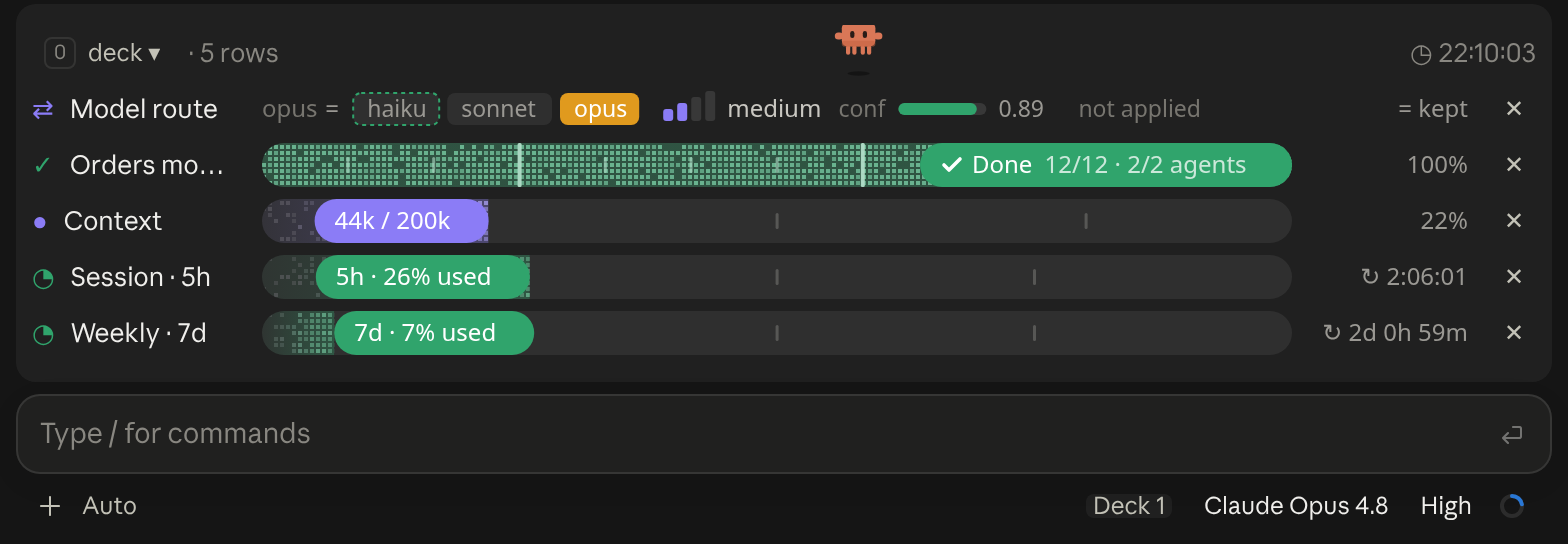
A cockpit for Claude Code: plan bars and subagent strips, context, usage limits with reset countdowns and burn rates, spend, the model route and a pet. Six bar styles, three collapsed looks. CLI and Desktop.

Terminal
❯ Run the tests again
● The repo is clean and the tests pass.
✻ Cooked for 0s · done 10:12 PM
 ☀ 44k │ 5h 26% │ 7d 7% │ cache 5%                                                              [-]
❯
Claude Desktop

One line above the prompt: context tokens with their weather, a bar per recent prompt, your 5-hour and 7-day limits against the time elapsed, the prompt cache with its time left, the session cost with the last prompt's share in dollars and in points of the 5-hour limit, and the subagents running. Labels in English, French or Russian. After Token Weather (Anthropic, Apache-2.0) and the ideas of usage-meter (HolyGrail) and prompt-cache-control (Daniel San).

Terminal
                                                                                                [-]
                                                                                    zZ
                                                                            ▀▄   ▄▀
                                                                        ▄▄▀▀▀▀▀▀▀▀▀▀       ▀▀▀▄▄▄
                                                                        ▀▀▀▀▀▀▀▀▀▀▀▀      ▀▀▀▀▀▀▀▀
 ctx 22%                                             [ Pet ♥ ] [ ⚙ ] [ ↻ Adventurer ] [ Hide ]
❯
Claude Desktop

A little pixel cat that wanders above the Claude Code prompt, watches your usage limits and announces when work finishes; or switch packs for an adventurer who mines, chops trees and fights zombies

Terminal
╭─────────────────────────────────────────────────────────────────────────────────────────────╮ [-]
│ ◆ context                                              44k of 200k · compacts at 167k  22%  │
│ ████████████████████────────────────────────────────────────────────────────░░░░░░░░░░░░░░░ │
│ ■ system prompt 1.9k 1%   ■ system tools 28k 14%   ■ skills 2k 1%   ■ messages 12k 6%       │
│ ─ free space 123k   ░ autocompact buffer 33k                                                │
╰─────────────────────────────────────────────────────────────────────────────────────────────╯
❯
Claude Desktop

Your context window as a stacked bar above the prompt, a color per category, with token counts and the compaction point. /context-bar shows or hides it.
