

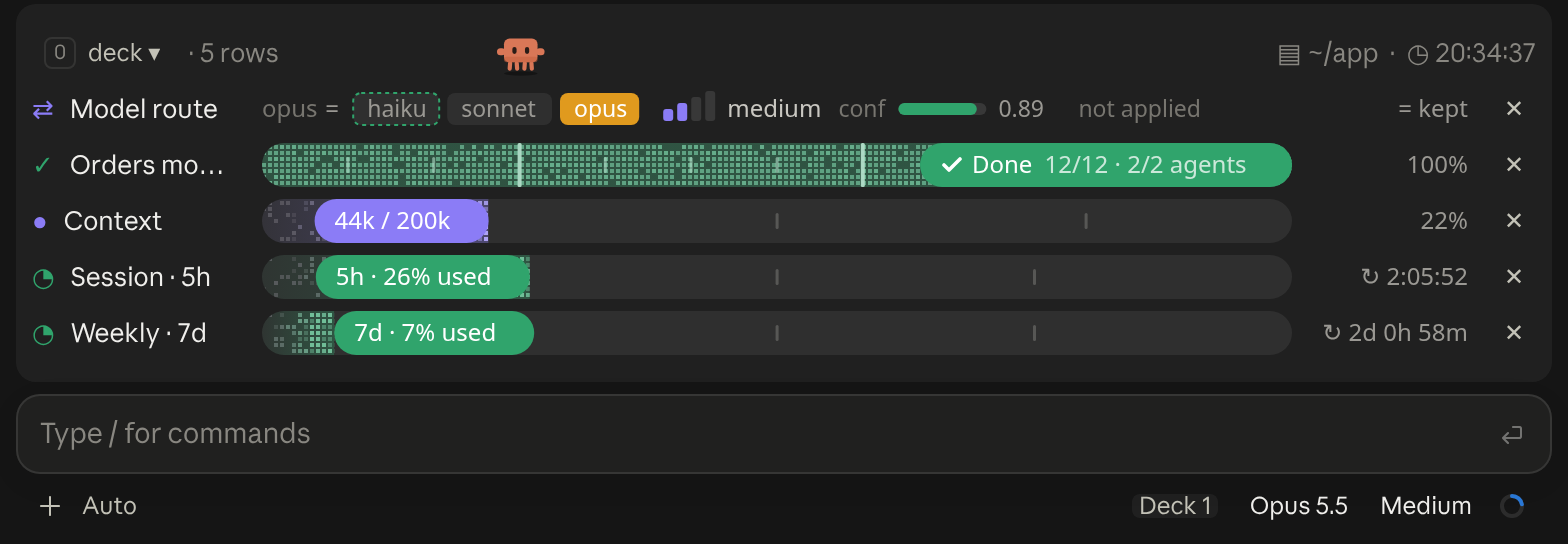
A cockpit for Claude Code: plan bars and subagent strips, context, usage limits with reset countdowns and burn rates, spend, the model route and a pet. Six bar styles, three collapsed looks. CLI and Desktop.
Terminal
▀▀▀▀▀▀▀▀▀▀▀▀▀▀                                                                                  [-]
▀▀▀▀▀▀▀▀▀▀▀▀▀▀
██▀▀▀▀██▀▀▀▀█▀  Noodle is humming quietly
▀▀▀█▀▀██▀▀█▀▀▀  ━━━─────────── 22% 5h ▰▱▱▱▱ 26%  week ▰▱▱▱▱ 7%  $0.20 ⓘ
▀▀▀▀█▀▀▀▀█▀▀▀▀
Claude Desktop

An animated pixel-art companion above your prompt that reacts to your session and your typing, with a live context meter.
Pixel Pet jumps up waving with an exclamation mark when a permission prompt appears, and says it needs your OK. When a turn of 30 seconds or more finishes, it waves until you're back. /pet sound on adds a soft chirp when it calls you.
The meter on its second line is a bar for the context window, then your plan's 5-hour and weekly usage, or the dollars billed on the API, Bedrock, Vertex or Foundry. Point at the info icon for tokens, reset times and how you're billed. It notes once when a plan limit passes 80%, and again at 95%.
/pet calm on keeps motion small, with no bobbing or scrolling. /pet scene off shows just the pet, and /pet hide tucks it away until you run /pet show.
No. It makes no network calls. It runs date +%z once a session for your time zone, writes ~/.claude/pixel-pet.json, and /pet card saves an SVG to your Downloads folder.
A cockpit for Claude Code: plan bars and subagent strips, context, usage limits with reset countdowns and burn rates, spend, the model route and a pet. Six bar styles, three collapsed looks. CLI and Desktop.

One line above the prompt: context tokens with their weather, a bar per recent prompt, your 5-hour and 7-day limits against the time elapsed, the prompt cache with its time left, the session cost with the last prompt's share in dollars and in points of the 5-hour limit, and the subagents running. Labels in English, French or Russian. After Token Weather (Anthropic, Apache-2.0) and the ideas of usage-meter (HolyGrail) and prompt-cache-control (Daniel San).
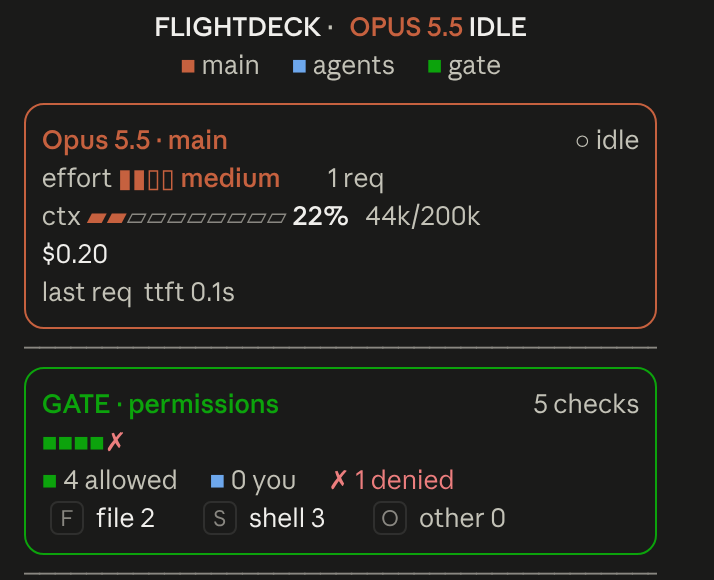
Flightdeck: a live agent dashboard for Claude Code. Main model vitals, an on-call architect, every permission check, subagent cards and swimlanes, a turn receipt and a session log, all from real session events
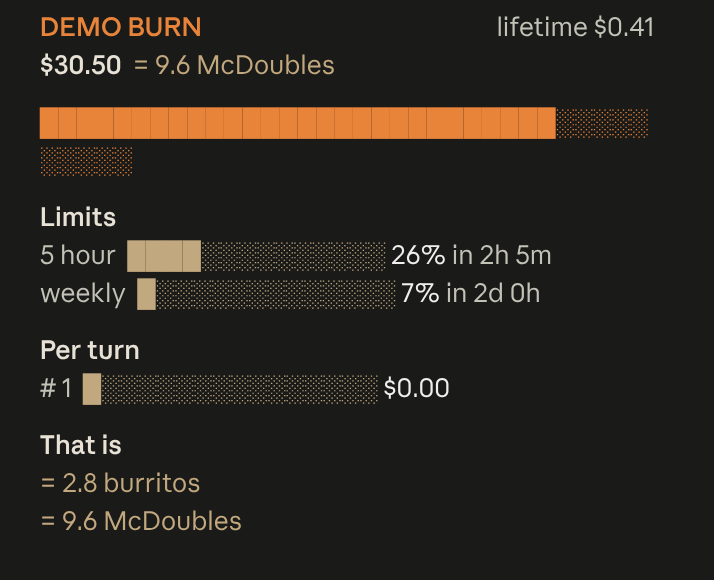
Live session cost odometer above the prompt: a burning fuse, real-world comparisons, threshold alerts
Opus 4.8 [high] ~/app main
16:20:55 | ⛁ ██░░░░░░░░ 22% | 5h ●◔○○○ 26% ↻2h7m | 7d ◔○○○○○○ 7% ↻2d1h │ $0.41 ⏱ 10m
Two-line status with a block context bar and quarter-step dot meters (◔◑◕●) for the 5-hour and weekly limits (fill shows usage, color shows whether you are ahead of or behind pace), plus model, effort, git and cost. Needs no jq.
  Opus 4.8 high ✦ │ ctx 22% │ app (main) │ PR #1287 ● │ $0.41 · 10m +128 -34
  Session ● ● ● ● ● ● ● ● ○ ○ ○  74% left  Resets in 2h 6m
  Weekly  ● ● ● ● ● ● ● ● ● ● ○  93% left  Resets in 2d 0h
  Fable   ● ● ● ● ● ● ● ● ● ○ ○  85% left  Resets in 2d 0h
  ◐ Read:index.ts  ✓ Read×1  ✓ Bash×1  ✓ Edit×1  ✓ Grep×1
  ◐ code-reviewer Review the change for regressions
A header with model, context and burn rate per hour, then live tool and agent activity parsed from the session transcript.
Model: Opus 4.8 | Thinking: high | Context: [▰▰▱▱▱▱▱▱▱▱] 45k/200k (22%) | cwd: ~/app | ⎇ main | (+0,-0)
Cost: $0.41 | Block: 2hr 6m | Weekly: 7.0% | Session: 10m | In: 916.7 t/s | Out: 29.2 t/s | Cached: 2k | Session: [▰▱▱▱▱] 26.0%
Mem: 0.8G/1.0G | (*゚∀゚*) | Session ID: b8e1c0d2-4a6f-4e2a-9c1b-3f5d7a9e2c10
Three lines in One Dark: model, thinking effort and a context bar up top; cost, quota, session clock and token throughput in the middle; weather, free memory and a rotating kaomoji below.
app · main · Opus 4.8 · high
ctx 22% 44k · 5h 26% ↻2h6m · 7d 7% ↻2d0h · cost $0.41 · msg $0.757
Two-line: dir/git/model/advisor/effort on top + Caveman, RTK, context %, 5h/7d rate limits, and session cost below


